When the City of Waukesha completed its transition to Lake Michigan water in October 2023, a lot of homeowners started asking the same question: Do I even need my water softener anymore?
It is a fair question. The city has been encouraging residents to remove their softeners, offering a rebate to do it, and the word around town is that Lake Michigan water is basically “soft.” So why bother keeping the equipment?
Here is what the data actually shows — and why the full picture is a little more complicated than the headlines suggest.
Where Waukesha’s Water Came From — and Where It Comes From Now
For decades, Waukesha drew its drinking water from deep groundwater wells. That water was extremely hard — averaging around 21 grains per gallon (gpg) of hardness. To give that some context, 21 gpg is deep into “very hard” territory by any professional measure. Scale buildup, spotted dishes, dry skin, shortened appliance life — all of that came with the territory, and most Waukesha households ran a water softener because they simply had to.
In October 2023, the city completed its switch to Lake Michigan water sourced through the City of Milwaukee. The new supply comes in at approximately 8 grains per gallon — a meaningful improvement over what came out of the ground before.
But here is what matters: 8 gpg is not soft water.
What “Soft Water” Actually Means: The WQA Hardness Scale
The Water Quality Association (WQA) is the industry’s leading credentialing and standards body, and their hardness classification scale is the professional benchmark used by water treatment experts nationwide:
| Classificatin | Hardness Level |
| Soft | 0 – 3.5 grains per gallon |
| Slightly Hard | 3.5 – 7.0 grains per gallon |
| Hard | 7.0 – 10.5 grains per gallon |
| Very Hard | Over 10.5 grains per gallon |
Source: Water Quality Association (WQA)
Waukesha’s Lake Michigan water comes in at approximately 8 grains per gallon — squarely in the “hard” category by the WQA scale.
Yes, it is dramatically better than the 21 gpg well water most residents grew up with. Going from 21 gpg to 8 gpg represents roughly a 60% reduction in hardness. That is real and significant.
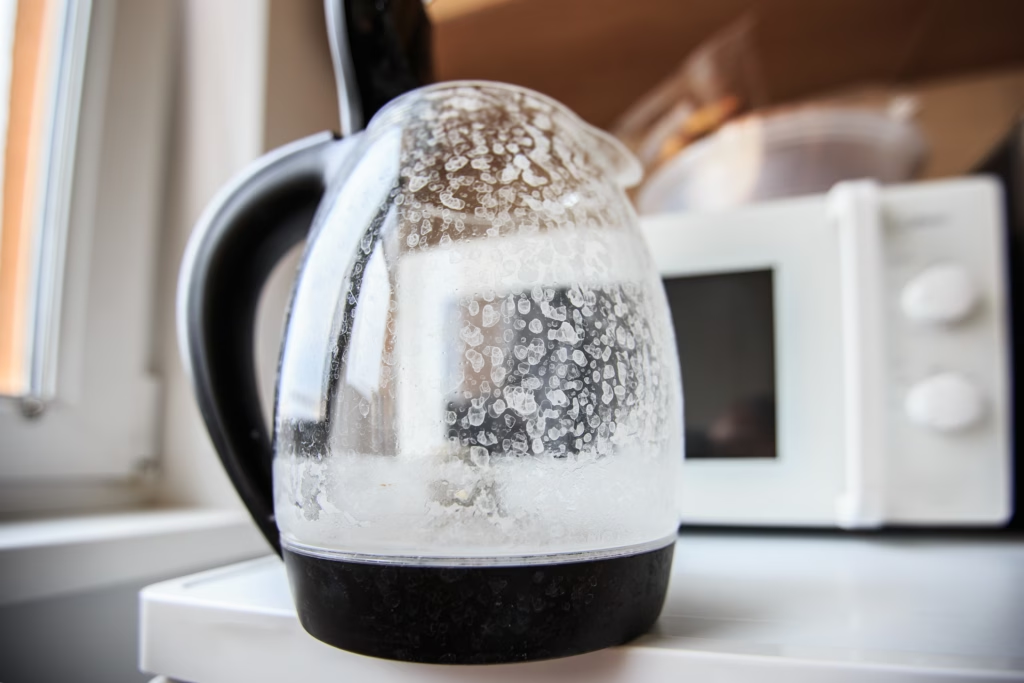
But calling Lake Michigan water “soft” is not accurate. At 8 gpg, your water still carries enough dissolved calcium and magnesium to cause scale on fixtures, reduce appliance efficiency, affect skin and hair, and shorten the life of water-using equipment. Soft water is considered 0-1 gpg, Waukesha’s new supply eight times that level.
So Why Is the City Encouraging Softener Removal?
This is where it helps to understand the “why” behind the rebate program — because the city’s goal and your household’s goal are not necessarily the same thing.
The rebate program is driven by chloride regulations. Water softeners regenerate using sodium chloride (salt), and that salt passes through the sewer system into the Clean Water Treatment Plant. Standard wastewater treatment cannot remove chloride, which means elevated chloride levels have become an environmental concern in the region. Federal and state standards have tightened, and the city’s response is to reduce the total number of water softeners discharging into the sewer system.
The city is currently offering a $150 rebate (reduced from the original $200 as of July 2025, while funding remains available) to sewer-connected homeowners who permanently remove their water softeners. That rebate is a real incentive — but it is worth understanding exactly what you are giving up in exchange for it.
Removing your softener at 8 gpg means:
- Scale accumulation on water heaters, dishwashers, and plumbing fixtures
- Increased soap and detergent usage (hard water does not lather well)
- Spotting on dishes, glassware, and shower surfaces
- Reduced efficiency and shorter lifespan on water-using appliances
The rebate does not offset those long-term costs. For many households, the math does not favor removal.
The Better Option: Optimization
Here is the part of the conversation that often gets missed: you do not have to choose between keeping your softener as-is or removing it entirely.
The city’s regulations do not require removal — they require that softeners be optimized. The deadline for optimization compliance was January 1, 2025. An optimized softener is programmed and calibrated to match your actual water conditions and household usage, so it uses only the salt necessary to do its job efficiently — no more, no less.
With Waukesha’s new water coming in at 8 gpg instead of 21, an older softener that was set up for your previous water supply is almost certainly overdosing — working harder than it needs to, using more salt, and discharging more chloride than necessary. Optimization brings those settings in line with the real water you have today.
This is the right path for most Waukesha households: optimize, not eliminate.
Why the Equipment You Have Matters
Not all softeners can be optimized to the same level. Older timer-based units — the kind that regenerate on a fixed schedule regardless of actual water use — are genuinely inefficient in the new environment. They were often already marginal; with softer incoming water and the same fixed settings, they can become a real problem.
Modern demand-initiated softeners, by contrast, regenerate only when they need to — based on how much water your household actually uses. That means significantly less salt consumption, less chloride discharge, and lower operating costs.
This is where Kinetico water softeners stand apart. Kinetico systems operate on a non-electric, demand-initiated regeneration cycle, meaning the system responds to your actual water use rather than running on a timer. Independent testing by the WQA under NSF/ANSI Standard 44 has confirmed that Kinetico systems are among the most salt-efficient softeners available — using up to 70% less salt than conventional timer-based units.
At Water Doctors, we have carried Kinetico products for over 40 years because they are engineered to last and built to perform consistently. In Waukesha’s new water environment, they are also an ideal solution for homeowners who want to stay in compliance with optimization requirements while actually protecting their home and appliances.
If you currently have a Kinetico system, getting it dialed in for the new water supply is straightforward. If you have an older conventional softener, we can evaluate whether optimization is feasible or whether an upgrade to a more efficient system makes more long-term sense for your household.
Frequently Asked Questions
Is Lake Michigan water soft? No. By the WQA’s professional hardness scale, water is classified as soft at 0 to 3.5 grains per gallon. Waukesha’s Lake Michigan supply comes in at approximately 8 grains per gallon, which falls in the “hard” category. It is significantly softer than Waukesha’s former groundwater supply (which averaged 21 gpg), but it is not soft water by any professional standard.
Do I need a water softener with Lake Michigan water? For most households, yes — especially if you want to protect appliances, avoid scale, and maintain water quality. The decision depends on your household’s tolerance for hard water effects and the condition of your plumbing and appliances. We are happy to walk through the specifics with you.
What is the City of Waukesha water softener rebate? The city is offering a $150 rebate (as of July 2025, while funding is available) to sewer-connected homeowners who permanently remove their water softeners. The rebate is designed to reduce chloride levels entering the wastewater system. Rental softeners are not eligible.
Should I take the rebate and remove my softener? That depends on your situation. The rebate is a one-time payment that does not account for the long-term costs of living with 8 gpg hard water — scale damage, increased soap use, appliance wear. For many homes, optimizing the softener is a better long-term decision. We can help you evaluate which path makes sense.
What does “softener optimization” mean? Optimization means calibrating your water softener to match your current water hardness and your household’s actual water consumption. Since Waukesha’s incoming water is now considerably softer than the old groundwater supply, most existing softeners need to be reconfigured. Optimization reduces salt use, lowers chloride discharge, and keeps you in compliance with city and state standards.
What is a Kinetico water softener and why does it matter? Kinetico is a premium water treatment brand known for non-electric, demand-initiated softeners that are independently certified by the WQA. They regenerate based on actual water use rather than a timer, which means they use significantly less salt — an important advantage in Waukesha’s new regulated environment. Water Doctors is a Kinetico dealer and has been for over 40 years.
How do I know if my current softener needs to be optimized or replaced? A water quality assessment from a trained technician is the best starting point. We test your incoming water, evaluate your current equipment’s settings and condition, and give you a straight answer on what makes sense for your home.
The Bottom Line for Waukesha Homeowners
The Lake Michigan transition is genuinely good news. Going from 21 grains per gallon to 8 is a real improvement in water quality, and Waukesha residents should feel good about that.
But 8 gpg is still hard water. The science on that is clear, the WQA classification scale is not ambiguous, and the practical effects of hard water — scale, appliance wear, lathering issues — do not disappear at 8 gpg. They just become less severe than they were at 21.
The city’s rebate program is driven by legitimate environmental goals around chloride reduction. But removal is not the only way to get there — and for most households, it is not the best way. Optimization is.
If you are a Waukesha homeowner trying to figure out the right move, Water Doctors can help you sort through it without a sales pitch. We will test your water, look at your equipment, and give you an honest recommendation. That is how we have operated for over 40 years, and it is not changing now.
Contact Water Doctors to schedule a free water quality assessment and find out exactly what your home needs in Waukesha’s new water environment.
Water Doctors is a water treatment company serving residential and commercial customers throughout Wisconsin. We are an Authorized Independent Kinetico dealer and have been helping Wisconsin families and businesses with water quality for over 40 years